AI is starting to change the process of medical discoveries of ways to help patients and researchers are now deploying sophisticated AI to speed up the process of identifying improved delivery materials of mRNA by many times. Although the mRNA technology has been on the spotlight of the world during the vaccine development, a major challenge that has not been resolved yet is the safe delivery of delicate genetic instructions into the human cells. It used to take years of trial and error testing of chemical combinations by scientists, but now AI models are able to analyze large datasets and create promising materials in a fraction of the time. Researchers think this transformation may open the door to quicker therapy, better inoculations and fresh medications on ailments that were previously rated as challenging to manage.
The complexity behind mRNA Delivery
mRNA molecules are very sensitive and decompose rapidly within the body. The scientists will need to devise systems that allow them to deliver genetic material to the cells safely without causing adverse immune responses through the development of protective delivery systems which in most cases are lipid nanoparticles.
AI Substitutes Sluggish Trial-and-Error Testing

In the past, the discovery of materials used to be done by manually testing thousands of chemical variations. In AI systems, they will be able to simulate the results at a digital level, which can be narrowed down to the most promising candidate, without the laboratory experiments starting.
Accelerated Route Between research and treatment

Scientists can reduce development timeframes by several folds by forecasting the success of specific materials. Medical innovation can be speeded up now because what took years to accomplish can now be accomplished in months.
Smarter Nanoparticle Design
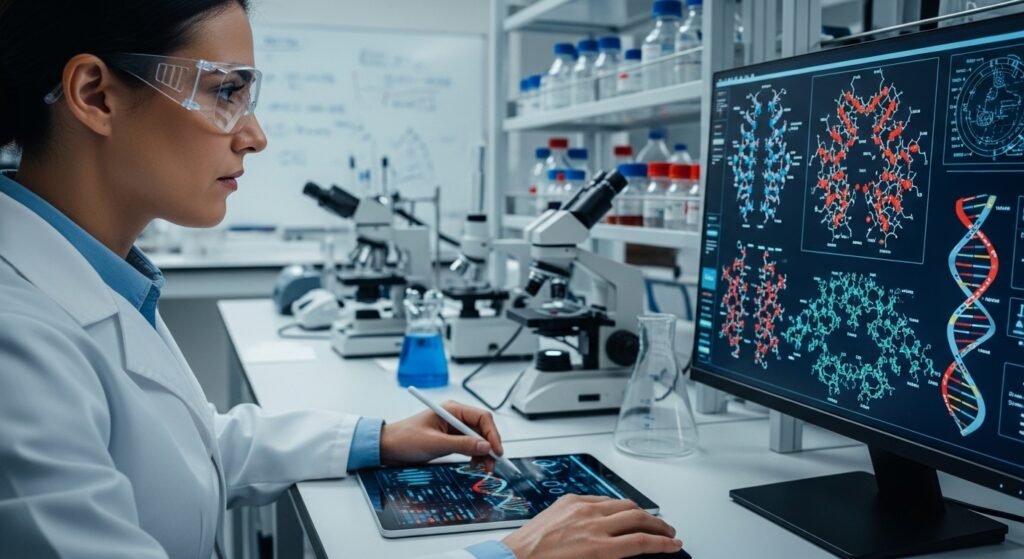
The AI models are used to study the structure, stability, and biological compatibility of molecules at the same time. This enables the researchers to model delivery particles used to target certain organs or treatment objectives.
Potential Beyond Vaccines
Better delivery systems have the potential to increase mRNA applications to not only infectious disease therapies but also cancer treatment, rare genetic diseases and personalized medicine strategies.
Cooperation between Biotech and AI

To improve the next-generation treatments and to scale discoveries even more effectively, biotechnology companies, such as the innovators like Moderna are actively researching AI-assisted research.
Reducing Research Costs

The use of AI in screening saves time and costs because laboratory resources are wasted on unprobable candidates only, and the research costs will decrease, as it will be concentrated on high-probable candidates only.
Less risky and More accurate Therapies

The use of improved delivery material has the potential to reduce side effects by making sure that therapies only get to the target cells, making them safer and more efficient.
Challenges Still Remain

Even with the fast development, AI predictions are yet to be tested in the reality. Biological systems are quite complicated and they must be thoroughly tested in the laboratory before clinical application.
The Discovery of the New Age in Medicine

The integration of AI and mRNA science points to one of the key changes in the sphere of healthcare innovation. With the constantly increasing capabilities of computational tools, researchers will be able to access treatments more quickly than ever before transforming the way future medicines are found and administered.
